***Version auf Deutsch unten verfügbar ***
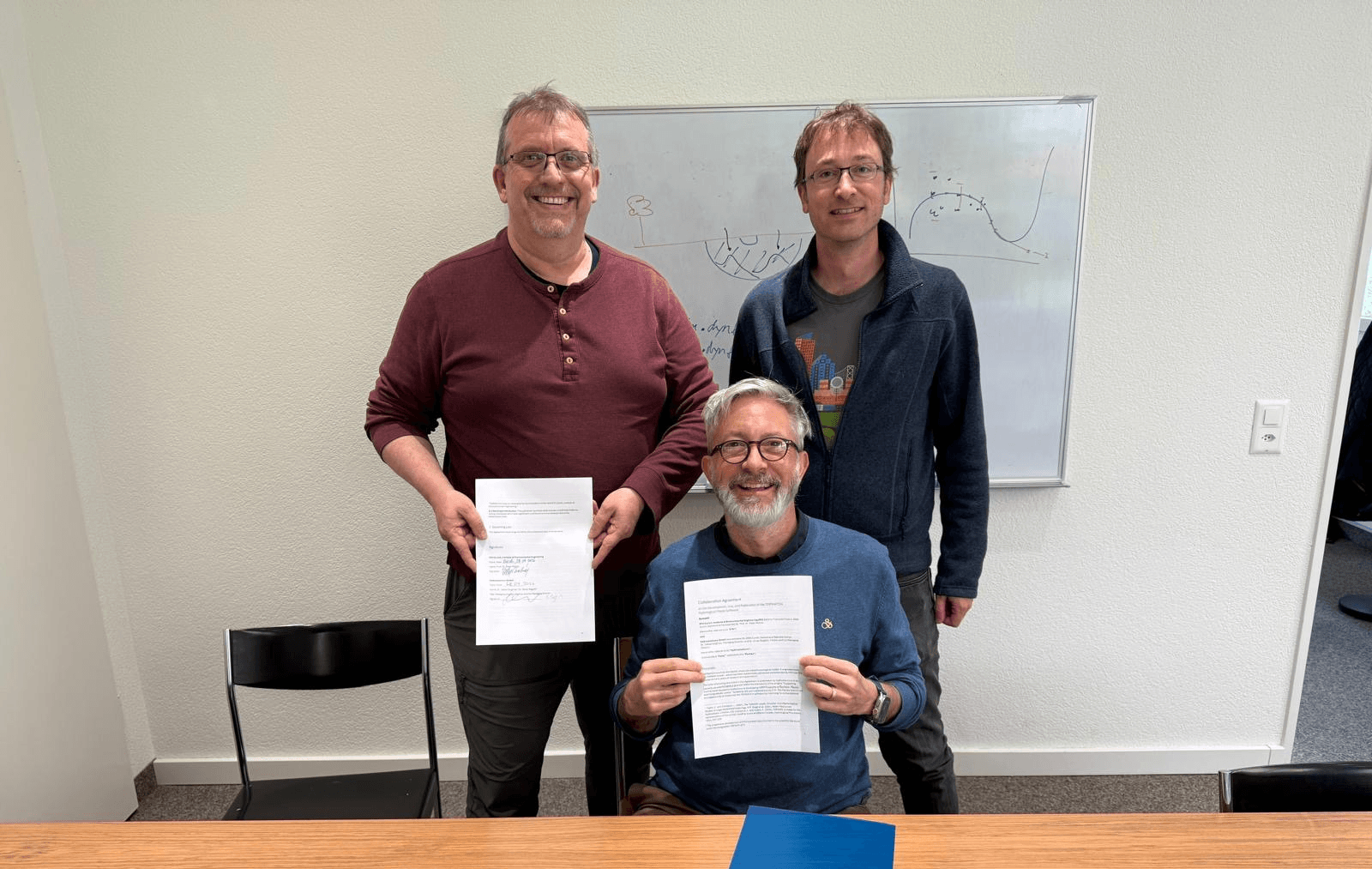
We are pleased to announce that hydrosolutions has signed a collaboration agreement with ETH Zurich's Institute of Environmental Engineering (IfU) on the development, use, and publication of the TOPWATCH hydrological model.
TOPWATCH is a hydrological model that simulates the full water cycle of a catchment in fine spatial detail, using the physical laws that govern how water moves through the landscape. The model originates from the TOPKAPI model and was previously known as TOPKAPI-ETH, reflecting many years of research and advancement at ETH. Under the agreement, hydrosolutions has modernized the codebase using AI-assisted code optimization.
TOPWATCH was rebuilt and restructured in Rust, a modern compiled programming language. In doing so, the model adopts a well-established principle from video game programming, where large virtual worlds have to be computed in real time: only those areas in which something is actually happening are actively computed. Applied to TOPWATCH, this means that dry parts of the catchment are only activated once rainfall or flowing water reaches them. The result: the model now runs roughly 30× faster than the most recent ETH version, while fully preserving its physics.
Why speed matters: stochastic risk assessment in mountain catchments
Designing flood protection in mountainous catchments requires reliable estimates of rare events — floods that may occur only once in 100 or 1000 years. This task is complicated by the fact that climate change shifts precipitation patterns and intensities, snowlines, and glacier contributions to runoff. Short observational records and the complex ways mountain catchments respond to a warming climate make classical approaches for flood hazard assessment unreliable.
A stochastic modelling framework addresses this by running the model for thousands of plausible storm scenarios. This requires two things: a physically based model that can credibly simulate a catchment's response to unseen combinations of conditions, and the ability to run that model over very long time series. Until now, physically based models were simply too slow for stochastic applications to be practical. With the refactored TOPWATCH, what used to take weeks now runs in hours.
Ready for real-world application
The Canton of Zurich's recent Natural Hazard Risk in 2050 and 2100 study estimated how flood risks across the canton will evolve under future climate scenarios. TOPWATCH can be integrated into workflows of this kind, accounting for hydrological processes in mountainous regions that have previously been treated in a simplified way. The computational efficiency of TOPWATCH opens the door to applications that were previously out of reach.
The collaboration brings together ETH's long-standing expertise in state-of-the-art hydrological modelling and hydrosolutions' experience in modernizing scientific software for operational use. Following a forthcoming joint publication, the new TOPWATCH will be released as open-source software.
-------------------------------
hydrosolutions unterzeichnet Kooperationsvereinbarung mit der ETH Zürich
Wir freuen uns, bekanntzugeben, dass hydrosolutions mit dem Institut für Umweltingenieurwissenschaften (IfU) der ETH Zürich eine Kooperationsvereinbarung zur Weiterentwicklung, Nutzung und Veröffentlichung des hydrologischen Modells TOPWATCH unterzeichnet hat.
TOPWATCH ist ein hydrologisches Modell, das den gesamten Wasserkreislauf eines Einzugsgebiets in hoher räumlicher Auflösung simuliert – auf Grundlage der physikalischen Gesetze, die die Bewegung von Wasser in der Landschaft bestimmen. Das Modell stammt vom TOPKAPI-Modell ab und war bisher unter dem Namen TOPKAPI-ETH bekannt, was die langjährige Forschung und Weiterentwicklung an der ETH widerspiegelt. Im Rahmen der Vereinbarung hat hydrosolutions den Programmcode mithilfe KI-gestützter Code-Optimierung modernisiert.
TOPWATCH wurde in Rust, einer modernen kompilierten Programmiersprache, neu aufgebaut und umstrukturiert. Dabei übernimmt das Modell ein bewährtes Prinzip aus der Programmierung von Videospielen, wo grosse virtuelle Welten in Echtzeit berechnet werden müssen: Nur Bereiche, in denen tatsächlich etwas passiert, werden aktiv berechnet. Übertragen auf TOPWATCH heisst das: Trockene Bereiche des Einzugsgebiets werden erst aktiviert, wenn Niederschlag oder fliessendes Wasser sie erreicht. Das Ergebnis: Das Modell läuft nun rund 30-mal schneller als die jüngste ETH-Version – bei vollständig erhaltener Modellphysik.
Warum Geschwindigkeit zählt: stochastische Risikoanalysen in Gebirgseinzugsgebieten
Die Bemessung von Hochwasserschutzbauten in Gebirgseinzugsgebieten erfordert verlässliche Abschätzungen seltener Ereignisse – Hochwasser, die statistisch nur alle 100 oder 1000 Jahre auftreten. Erschwert wird diese Aufgabe durch den Klimawandel, der Niederschlagsmuster und ‑intensitäten, Schneegrenzen und den Gletscherbeitrag zum Abfluss verschiebt. Kurze Messreihen und die komplexe Reaktion von Gebirgseinzugsgebieten auf ein wärmeres Klima machen klassische Ansätze der Hochwassergefahrenanalyse unzuverlässig.
Ein stochastischer Modellansatz begegnet diesem Problem, indem das Modell für tausende plausibler Niederschlagsszenarien gerechnet wird. Dafür braucht es zweierlei: ein physikalisch basiertes Modell, das die Reaktion eines Einzugsgebiets auf bisher unbeobachtete Kombinationen von Bedingungen glaubwürdig simulieren kann – und die Fähigkeit, dieses Modell über sehr lange Zeitreihen laufen zu lassen. Bisher waren physikalisch basierte Modelle schlicht zu langsam, um stochastische Anwendungen praktikabel zu machen. Mit dem modernisierten TOPWATCH dauert das, was früher Wochen brauchte, nun nur noch Stunden.
Bereit für den praktischen Einsatz
Die kürzlich veröffentlichte Studie Risiko durch Naturgefahren 2050 und 2100 des Kantons Zürich hat abgeschätzt, wie sich Hochwasserrisiken im Kanton unter künftigen Klimaszenarien entwickeln werden. TOPWATCH lässt sich in Arbeitsabläufe dieser Art integrieren und berücksichtigt dabei hydrologische Prozesse in Gebirgsregionen, die bisher nur vereinfacht behandelt wurden. Die hohe Recheneffizienz von TOPWATCH eröffnet Anwendungen, die bisher ausser Reichweite lagen.
Die Kooperation verbindet die langjährige Expertise der ETH in modernster hydrologischer Modellierung mit der Erfahrung von hydrosolutions in der Modernisierung wissenschaftlicher Software für den operationellen Einsatz. Im Anschluss an eine gemeinsame wissenschaftliche Publikation wird das neue TOPWATCH als Open-Source-Software veröffentlicht.

%20copy.png)
